
Urban Farm
One of the P.F.1 volunteers picks vegetables in preparation for last night’s event.
Summer kicks off in earnest today with the official opening of the annual Young Architects Program installation at P.S. 1. This year, WORK Architecture was selected for their ambitious vision of transforming the angular concrete courtyard into a lush urban farm. We got a sneak peak of P.F.1 (Public Farm One) last night.
Architects Amale Andraos and Dan Wood created a living structure of plants and vegetables out of inexpensive, recyclable materials. Large tubes of coated cardboard filled with a clever combination of fabric inserts and soil are connected into a sweeping wave, creating a kind of flying carpet of food. It’s as if a farm has blown in and landed in Queens. (It reminds me a bit of Bill McDonough’s plans for rooftop farms in the Chinese city of Liuzhou).
Each cardboard barrel contains a different type of produce, from tomatoes and chard to herbs and collards. According to the architects, there is enough paper in this installation that if unfurled, it would reach the top of the neighboring Citibank building which can be seen towering in the distance beyond the trellises for the tomatoes. Beneath the structure are a pool, some shaded seating areas, and more herbs. Unlike the ambitious volunteer scaling the top of the farm last night, access to the produce was designed from below: Strategically placed holes in the structure allow people to mount a ladder and harvest the crops. Wood demonstrated, donning a green apron with pockets for the food.
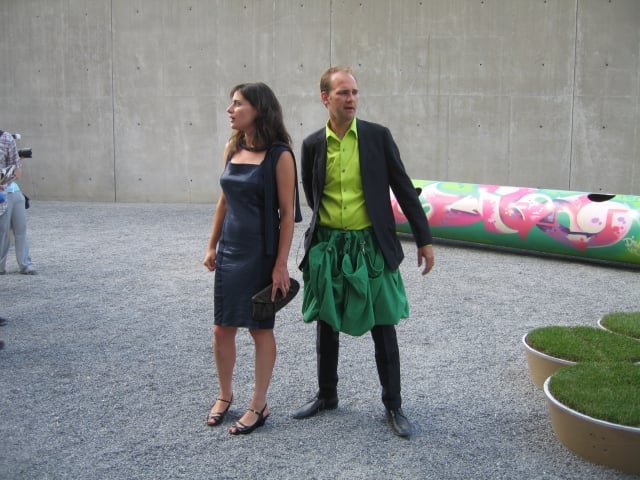
Andraos and Wood (wearing the green apron for harvesting produce) answer questions about their concept.
The design is a wonderful marriage of resources and resourcefulness. It was quite a logistical feat of collaboration, with over 100 volunteers giving time, financing, energy, consultation, and supplies. The water to feed the farm is being siphoned from P.S. 1 roof runoff and collected in a cistern. This sits in the chicken coop, which apparently came as a surprise to P.S. 1 Director Alanna Heiss, who did not know actual farm animals would be involved. Chickens and baby chicks peck about in a small hay-filled space and one of those paper tubes was used to fashion their roost. One resourceful hen pecked at the base of the water tank to get a drink:
The bird is about to take a drink from the pipe: it gets underneath, inverts its head, and sips.
For an urban farm, the rest of the installation feels sparse— little “benches” of grass and rubber, centered by herbs, are sprinkled throughout the gravel yard. There is a graffiti-covered “tunnel of love” for people to crawl through, which resembles an oversized version of the hay-filled tunnel used to house the chickens. Instead of pecking at a water pipe for sustenance, there is a docking station for all types of electronic devices, so us urban animals can hook up to the electronic teat and refuel our various gadgets.
Lisa Maione, our assistant art director, was with me last night and she commented that as a space to be experienced, it left her wanting. “The need for shade and cozy places to huddle and speak to new friends is what I look for in these installations in the garden. Much of the overhead area is left open and bare, seemingly unaddressed. It feels like a pulled-back version of what could have been.”
It’ll be interesting to see how this space fills in and evolves over the summer.
The flying carpet of food juts out over the wall of the courtyard.
Seen from underneath: the names of the food in each planter are spraypainted on the wood below, making it easier to harvest.
Additional gardens are scattered throughout.


Twitter
Project Haiti IV
Q&A: Core77
Call to Arms
Living with Guild
Architecture for the Other 99%
Behavior, Bicycles, and the Best Intentions
Celebrating the class of 2012 Game Changers
Black Locust: the Sustainable Hardwood of our Future?
Q&A: Guy Horton
Local Hero


Arghh - urban farms! Am I the only one who can’t see the point of this?
Real farms don’t need to look cool - because they are places of work.
I think the image of the balding designy-looking guy in a fluorescent shirt and gardener’s kilt sums up the absurdity of this quite nicely.
This may be the “jump the shark” moment for PS1.
Comment by david — June 21, 2008, @ 7:56 pm
What are all the theatrics for? All of a sudden everyone is into tomato. What’s a poor guy who lives in a studio apartment with a roommate to do? Go to museum and enjoy a party with all the yuppies with new toys and eat carrots?
No thanks. Innovation is elsewhere. This is like a tootpaste we already know about.
Comment by honeybomb — June 22, 2008, @ 6:20 pm
This is just like Urban Homesteading Project’s piece at the EMERGENCE show on Governors Island called Summer Homestead. It is a very geometric structure where recyclable bottles are used as pots for edible plants, hung from various rungs on the wooden frame. Visit http://www.emergenceshow.org to see the piece.
Comment by Joyce — June 22, 2008, @ 10:28 pm
This is a pathetic project, a very poor choice of the jury.
I wish that the winner was MONAD or su11, much better designers for a PS1 installation!
Comment by natalie — June 23, 2008, @ 6:59 am
For the poor guy who lives in a studio apartment with a roommate, here’s perhaps a more practical/portable version of this idea, for the apartment dweller’s rooftop or fire escape:
http://intranet.risd.edu/ngallery/albums/189.aspx
Comment by Jill — June 23, 2008, @ 9:26 am
Jill, that’s grreat! Thanks for the pepper tip.
Only thing is though, no access to roof, fire escape is banned for knick knacks and super don’t want anything in front other than trash.
Comment by honeybomb — June 23, 2008, @ 4:06 pm
moma/ps-01 young architect’s program is an exercise not only in good design, but resourcefulness, innovation, and commitment at the expense of the livelihood of young practices. these architects should be commended for completing their design in a prohibitive timeline and suffocating budget.
Comment by maria — June 23, 2008, @ 4:36 pm
PF1 looks so primitive! a design 1 student can do better with recycled toilet paper cylinders…
Comment by natalie — June 23, 2008, @ 6:22 pm
I think this is quite interesting may be the execution is not top notch, I am tired of seeing variations on deleuze theories for PS1 installation entries. These guys seem resourceful and the idea seems interesting/fun and in my opinion wouldn’t be developed by a design (1) student..:-))
Comment by sokomono — June 25, 2008, @ 10:01 am
I may be a humble boy from the Midwest/ Appalachia countryside, but I feel this PS1 Young Architects pavilion is inspiring. One, they are taking the time and money to develop such a project. Two, they are hitting on an issue that should be in the mindset of many designers, the world’s food shortage. It is true that the project is simple, but it makes the most out of that simplicity. It provides a functional piece that does more than keeps hipsters, DJs, and socialites cool and out of the sun. WORK’s project has created a dynamic and inspirational pavilion without going overboard with computer generated algorithms that may or may not ever be able to be constructed. When people start complaining about things for being to simple or lacking complexity I always like to drop this quote on them from E.F. Schumacher: “Any intelligent fool can make things bigger, more complex, and more violent. It takes a touch of genius - and a lot of courage - to move in the opposite direction.”
Comment by Timothy — June 25, 2008, @ 2:24 pm
This project would be very powerful 10-15 years ago. Now it is only a green design blog news for few days.
Comment by aspen — June 26, 2008, @ 12:33 am
It’s just retarded.
Comment by Andrea — June 26, 2008, @ 6:01 pm
I have been there and it is inspiring! Not really as slapdash as it may look in photos, the construction is actually pretty awesome and it is nice to see the top all abloom. The fact is, the area of the farm is completely doubled at the groundund with seating, misters, fans, swimming pool, videos, solar-powered phone chargers, videos, sounds…so it is almost as if the farm part is a kind of added bonus. And it actually looks as if the whole thing is 100% off-grid, which is pretty amazing to pull off anywhere. Plus there are chickens.
Comment by Pylax — June 26, 2008, @ 11:36 pm
LAME.
Comment by Tony T — June 29, 2008, @ 1:51 am
Well, its interesting to see that in all the above comments criticisms about this project is unsubstantiated, while the commendations are based on some good reasoning.
What influences our opinion about a design project? Its adherence to some unwritten code of urban style/chic dictated by whimsical designers of the time/age? My sincere condolensces to the poor guy in the studio apartment who lives with a roommate, that he can’t think beyond his 40 hr week and weekend partying. The poor guy would’nt know where the rice for the Mexican dish he orders at the restaurant comes from. Maybe he would know better if his studio apartment was in New Orleans when Katrina hit it.
The project addresses issues that need to be dealt with. The jury’s decision is appreciable, and architecture needs more human intelligence than that of a machine that can generate metaballs.
Comment by Sundar — June 29, 2008, @ 3:29 pm
Great Idea………I like it. Whatever the produce, the place is green and that’s what matters most.
Comment by Sabir — July 1, 2008, @ 10:19 am
OK, folks, let’s be design professionals here. Comments like “it’s retarded” or “LAME” aren’t critiques, they are unbacked opinions. You need to respond to and comment on scale, materials, form, vernacular, etc. And the first comment - about places of work not needing to look cool - well, just think about that for a minute. Most award-winning buildings are places of work: concert halls, corporate headquarters, libraries, architecture offices. Farms (and farmers) are no less deserving of thoughtful design than are advertising firms and embassies.
My own critique of the P.F. 1 project is that it is fairly well designed for what it is, essentially a piece of installation art in which you can grow tomatoes. I don’t see that it has much application in the factory-scale required for actually feeding large amounts of people, and every piece of the project isn’t successful, but they have pushed the design beyond what could be found in product catalogs. Besides, this isn’t meant to be a factory farm, it’s meant to have a little spirit beyond only utility.
As Vitruvius noted: commodity, firmness, and delight. Critique those qualities and you will add something to the discourse, and to design as a whole.
Comment by James — July 1, 2008, @ 4:32 pm
I haven’t been back to the P.F.1 space since I wrote this blog on opening night. If anyone visits the installation, snap some photos and I can post them here. It’d be interesting to see how the plantings evolve over the summer. Send those to me at: elizabeth@metropolismag.com. Be sure to put “P.F.1 Photos” in the subject line.
Comment by Elizabeth Evitts Dickinson — July 2, 2008, @ 9:44 am
Bad choice of materials imo. The stuff is made out of cardboard. Ever put a bunch of dirt in a cardboard box and leave it outside for a few years? Didn’t think so. (Scrap PVC pipe or cut-up scrap plastic barrels would have been a better choice from a practical stance)
It’s a nice idea about trying to make urban gardens cool (and I do believe there’s a huge sleeper-demand for urban gardens in NYC.)
Poster#2, yeah, there’s options. Also check out those upside-down tomatos (peppers and ornamental peppers work great too). Don’t buy the ones on TV, just make one out of spare junk hanging around. Put it in your window. The concept really does work.
Poster#8, no you couldn’t do better with recycled toiletpaper…because the design has a massive flaw (reread first paragraph of my comment).
Comment by Heath — January 27, 2010, @ 3:18 pm
Imagine the Year 4000, after petroleum as long since disappeared. How will city dwellers access food? I have been playing around with some large-scale, infrastructure projects for the past 30 Years, and would like to help more Americans come to terms with the fact that we have 2% of the world’s petroleum on our territory, but consume 20% of its annual supply. When will that situation crash, badly?
There are many design solutions, some on my website, and we must all keep going if the generations that follow are to have anything livable!
Comment by Mr. Kim Gyr — January 7, 2011, @ 8:52 pm