
Accessibility Watch: Cities Crying Out for Simple Fixes
I have never before muscled in on presentations when I’ve been asked to moderate a panel, but this time I did. It was last week at Build Boston, during a full-day symposium on socially sustainable design, when I broke my neutrality rule and showed some examples that make New York City—and other American cities too—an obstacle course for people with some disability or another. The topic of our panel, “New Models of Home for our Third Age,” made me think about how dense urban settlements, with their notoriously small living spaces, invite us to make the city itself into our living rooms (lecture halls and exhibition spaces), dining rooms (restaurants), and backyards (parks). What with the growing discussion about the advantages of urban living for aging populations—mostly because of easy access to goods and services—I wanted to call attention to the reality of our cities: how inaccessible they really are, and how much remedial work they need at every turn.
What follows are photos of three places that our publisher, Horace Havemeyer, has identified as problematic. How does a man with forearm crutches, who likes to eat in restaurants and visit cultural institutions, get past such thoughtless or piecemeal amenities? I also included one small, hopeful sign for the future.
.

How to get there?
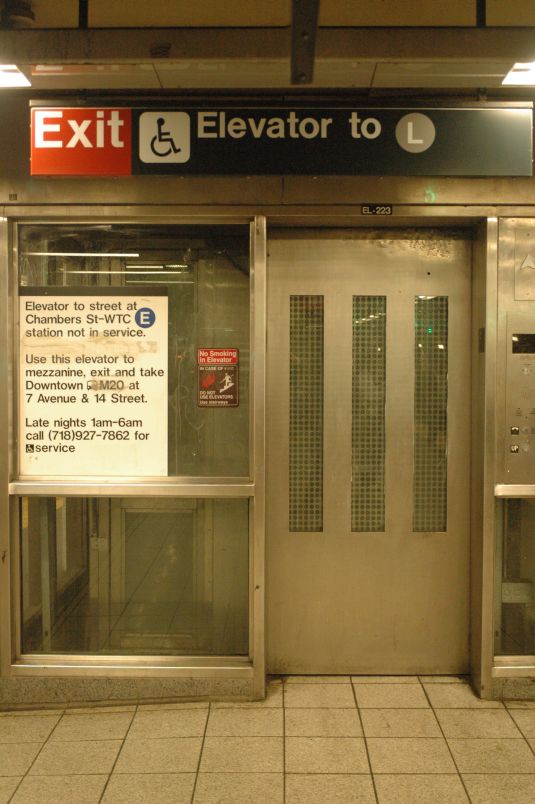
Elevators in the NYC Subway—seen here from the ACE platform at 8th Avenue and 14th Street—are only half of the great obstacle story. To get to the L train you must take this elevator to a mid-level platform, then switch to the L train elevator. But you are not allowed to use the ramp on the L platform because it’s not ADA acceptable. Eve Dilworth, who took these pictures, did not see an elevator that goes to the street level. Later she found out that there are 468 stations in New York City and a total of 63 elevators. Among other details of subway inaccessibility—in addition to non-existing and non-functioning elevators—the MTA provides the following recommendation: At some non-accessible stations you can transfer on the same platform to a train that later stops at an accessible station.
.
Our dining room away from home
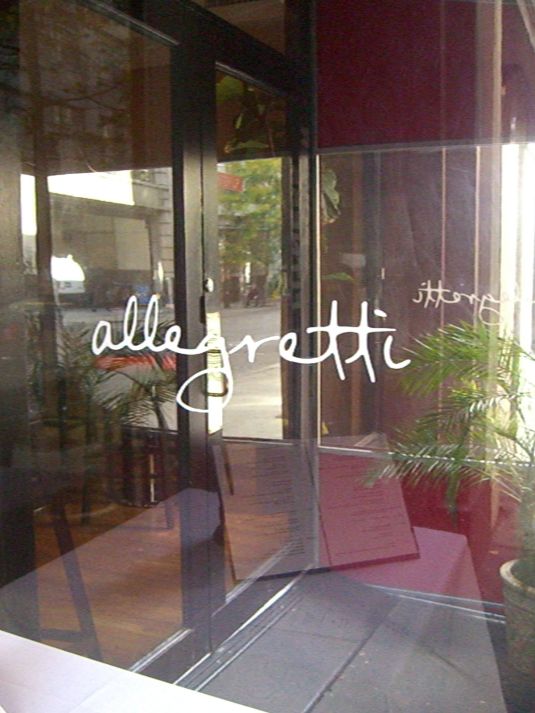
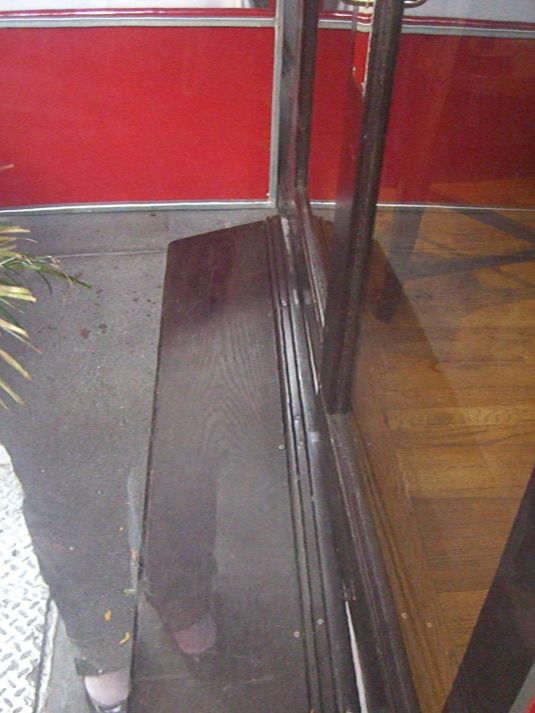
Allegretti, at 46 West 22nd Street in the Flatiron district, is known for its “old world grandiosity,” crisp linen tablecloths, and a courteous staff that helps those who request assistance. But the courtesy does not extend to the front door, where an awkward ramp makes it hard to go into and come out of the restaurant for someone whose step isn’t as sure as it used to be.
.
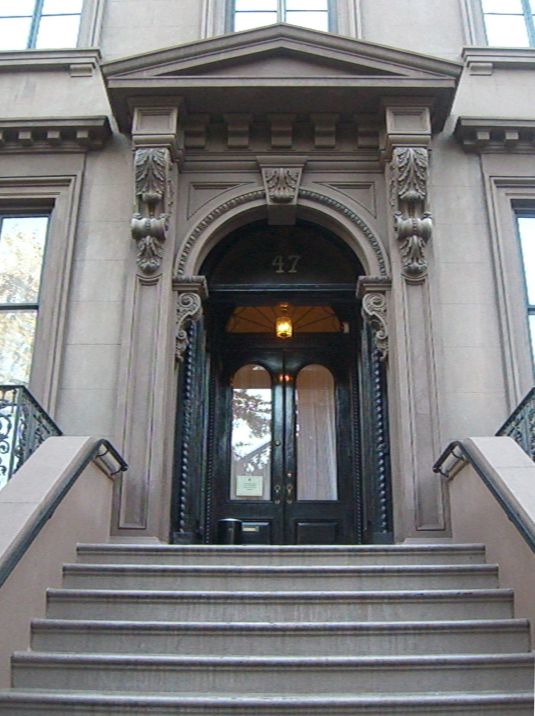
Our living room away from home
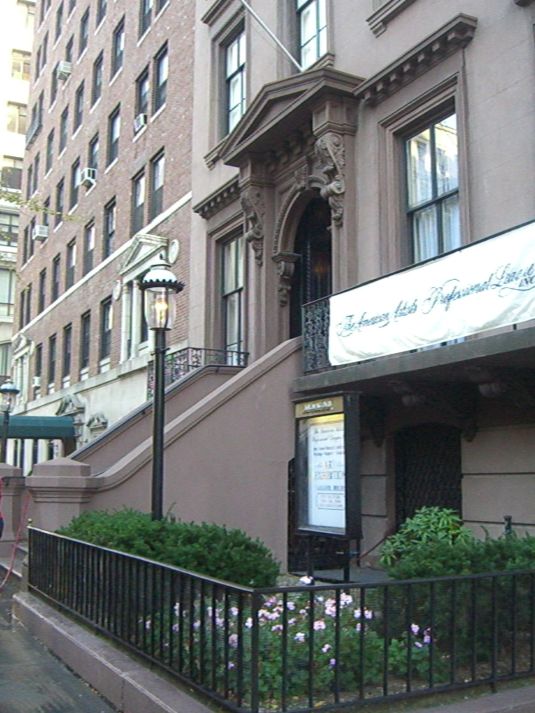
The Salmagundi Club, at 47 Fifth Avenue, is a townhouse that began life in 1871 as an artist’s studio and became a place to see the work of artists, learn to paint, and attend lectures. Known through the years as a gathering place for the likes of Child Hassam and Louis Comfort Tiffany, as well as Bucky Fuller, it is less welcoming to those who need help getting up and down its steep front stoop. The disabled are directed to take the stairs to the basement (far right), which forces them to climb even more stairs once they’re inside. Does being a landmark exempt the Salmagundi from accessibility?
.
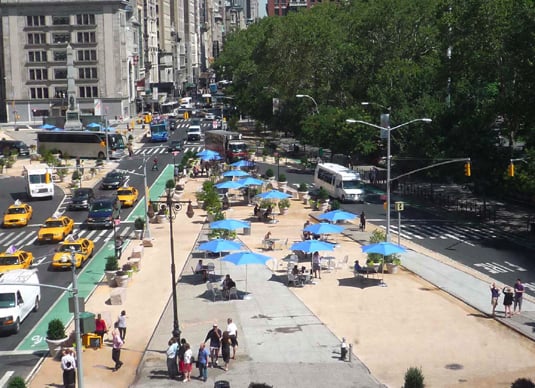
Our urban backyard
The recent campaign by the Bloomberg administration to remake New York’s streets for people, not cars, gives some hope for a more accessible city. In the middle of Broadway and 23rd Street, the backyard to the Metropolis offices, we now have a place to sit, in the middle of traffic. It’s OK to walk slowly here. A small sign of improvement, but we have a long way to go to make our city accessible for all.
Related: At the same Build Boston panel, Elizabeth Evitts Dickinson presented some examples of better-looking and greener retirement housing. Previously in our “Accessibility Watch” column, Horace Havemeyer wrote about the clash between universal design and historic preservation.


Twitter


As an increasingly disabled person I find both Susan’s and Horace’s observations most important. New York has consistently had an “attitude” toward the disabled whether in the subway or its many older buildings. California passed Title 24 disabled access rules tied to building permits over fifteen years ago (well before ADA)and while not perfect, San Francisco is a much more accessible city because of it. Every renovation project in San Francisco must use a percentage (which varies) of the construction budget to meet the Title 24 requirements. Even with that, Horace and I have had some adventures here. As the population ages, we are all going to be facing increased needs for accessibility. Thank you both.
Comment by Eric Engstrom — December 2, 2009, @ 7:06 pm
I really have to ask what the issue is with the ramp at Allegretti? Did you measure the ramp to see if it was within the ADA guidelines? I am not defending them but as a Physical Therapist I have studied and use the ADA guidelines on a regular basis. I also live on the same block as Allegretti and have been several times.
If you have not measured the ramp then you cannot publish pictures of a business with POTENTAILLY false information about that business.
Comment by question — December 2, 2009, @ 7:35 pm
I find the photo of the restaurant with the little ramp an interesting choice… I imagine it would be easy to find a business with a little step at their entrance who has not tried to fix the problem…. obviously a longer ramp is better, but isn’t a bad ramp better than no ramp? Am I getting philisophical now?
I’d also be curious to hear what proposed solutions are for the hertiage building…. what could be done? (I’m baffled as to why they would direct people with mobility issues down only to go up again, that’s weird.)
Comment by LB — December 3, 2009, @ 5:08 pm
I still would like to know what gives this site and author the right to falsely accuse Allegretti, but for now I’ll address LB. A larger ramp is not better, the length and slope are clearly stated in the ADA guidlines. I now question not only this site’s accuracy but the knowledge of it’s readers.
Comment by Question — December 3, 2009, @ 7:18 pm
ADA guidelines seem to tolerate minimal compliance, and damn the real needs of the disabled. Just think of those silly braille signs on hotel rooms and elevators—how is a sight-impaired person supposed to find his or her way to those tiny signs? More systematic solutions are needed, not patchwork remedies.
Comment by sss — December 4, 2009, @ 3:32 pm
What we look for is the spirit of ADA not just conforming to the code. I suggest that the defenders of Allegretti borrow a cane, crutch, walker or wheel chair and try to go into and out of the restaurant with them. I have.
Comment by Horace — December 7, 2009, @ 5:07 pm
Wow. I mistakenly thought the point of this series of posts was to help inform people about what the real needs are when it comes to accessibility. Apparently the point is to slam others for not already being knowledgeable. I’ll keep that in mind in case I ever make the mistake of considering commenting on another post - thanks.
1. by larger I meant longer and thus with a lower rise. Obviously.
2. Yes, clearly meeting ADA guidelines is what a business should do.
my point was that there are a zillion businesses that don’t meet ADA guidelines and have not attempted to do anything to make the situation better. The business in the photo has tried and failed. What’s worse, trying and failing or not trying?
Comment by LB — December 8, 2009, @ 2:01 pm
Trying and failing (or even partially succeeding) is just not good enough. It used to be that we were once recognized for high achievement and lasting contribution to problem solving, not just trying. How about figuring out real, brilliant solutions instead of defending the dull status quo?
Comment by sss — December 8, 2009, @ 2:35 pm
Horace, I have. I suggest you study the definition of libel, I have.
Comment by Question — December 16, 2009, @ 8:57 pm
Apparently most of the commenters have never spent an extended period in a wheelchair or empathize from that perspective. Instead I find it sad that Horace is under attack for making supposed false accusations rather than being asked why he chose to comment about Alagretti’s “ramp” in such a way.
As a wheelchair user myself there are many issues with a “shortened ramp” in the photograph above. Due to the limited space in front of the door it’s a necessity to make a sharp turn, therefore tilting the chair in such away that could lift the chairs wheel off the ground(one wheel on the sidewalk, one still in the door, and two teetering back and forth), which when the wheel does make contact with the ground could launch you into the wall – which could be very humorous to onlookers but incredibly embarrassing to you. Another example, is pushing a chair out of the restaurant and down the ramp only to get your footrests caught on the cement causing you to fall out of your chair, which could result in a potential lawsuit to the property owner.
Comment by cs — March 9, 2010, @ 12:54 am