



December 18, 2009
Q&A: Andres Duany and Jeff Speck on The Smart Growth Manual
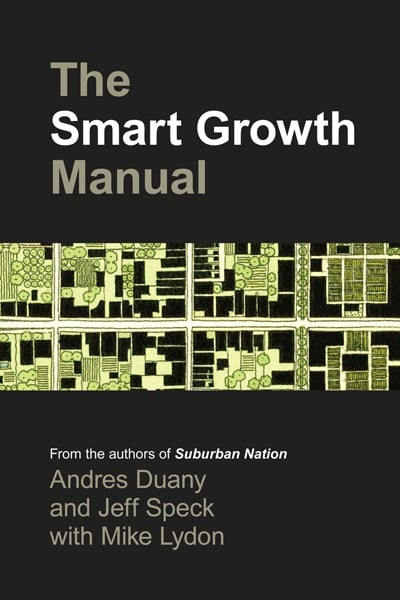
Who dares say what counts as “smart” when neighborhoods evolve? Look no further than the beige-and-black cover of The Smart Growth Manual. That’s the guide to repurposing American land use, not a guide. Who could claim such authority? Look down the cover for the author credits: this is a volume “from the authors of Suburban […]
Who dares say what counts as “smart” when neighborhoods evolve? Look no further than the beige-and-black cover of The Smart Growth Manual. That’s the guide to repurposing American land use, not a guide.
Who could claim such authority? Look down the cover for the author credits: this is a volume “from the authors of Suburban Nation,” Andres Duany and Jeff Speck, whose indictment of sprawl in that book inspired legions of citizens to learn mind-numbing public review procedures in order to give their towns a center again. Now Duany and Speck (who is a Metropolis contributing editor) say that this book is a go-to resource for citizens who have enlisted in that fight, complete with rounded corners for easy thumbing. Actually, they say it’s the go-to resource. It situates places along a rural-urban continuum and lays out how people should plan, circulate, live, and work in those places for a healthier life and climate.
Unsurprisingly, the authors easily defend their claims. We caught up with them via conference call with Speck in Washington, D.C., and Duany in Miami. An uninhibited discussion, with stirrings of a sequel, followed.
Who’s the audience?
Andres Duany: This is a response to the empowerment of citizens in planning. The public process has become very broadly based—it’s expected now [that citizens will participate in charettes] and often the outcome is questionable. That has to do with expertise. So this manual is for elected officials and for citizens who participate in the [planning] process.
Jeff Speck: You can read it in the public hearing, while you’re waiting for your project to come up.
AD: Which is why it’s a pocket book. This is very difficult, to get it down to something this succinct, because it’s always easier to show off how much you know. Beyond the issue of clarity, just being selective is what the discipline of writing is. One more thing about the methodology: Jeff plowed through the literature of smart growth, to make sure all their concerns were included.
JS: We talk a little bit in the beginning about how different organizations promulgate different visions that, unsurprisingly, align with their personal missions. But the contradictions one finds take the form almost entirely of omissions—you find very little disagreement, just that some people stress some points and others reverse it.
AD: Most organizations are specialized—or, as the French say, they’re professionally formed.
There’s not a lot of discussion of the political process in the book, though.
AD: The political process is implied throughout. We’re constantly saying that government should do this. I’m not sure we included the disagreements—what we’re up against.
JS: If what you’re noticing is that there isn’t much about how to get involved or how to work the political process, you’re right—that is quite different from place to place. But as Andres suggested, the political process is everywhere in this book—the whole second chapter is about how to make a regional plan, which is a political act. We also talk about different scales of governance including [the idea of a] shared tax base, which makes smart growth possible.
AD: We do not present the argument of the Libertarians or disurbanists against smart growth.
JS: A more direct answer: This book is about what smart growth is, and we’re confident people can use it to proper effect.
Did you give thought to talking about why it’s hard to achieve smart growth through democratic means?
JS: It’s important first to have an understanding of principles.
AD: Hey, one thing I was going to say about the tone of the book: There are assumptions that you’re already on board—the tone has a certain urgency, basically go out and do this. Urgency is an aspect in climate change which is a new ingredient in American planning. American planning is exceedingly procedural, and it’s not unusual to take years to get a project done. Obama has added urgency to government. There’s urgency to this book that you might have found unusual two years ago—or we might have!
JS: [laughs] It is nice that because the smart growth movement explicitly aligns the urbanist movement with the green movement, it brings planning to a level of relevancy and urgency because of climate and financial crises.
The book assumes a lot of power in the hands of planners.
AD: Well, in the real world the power is entirely in the hands of the planners—this book is not for professionals, and planners aren’t going to like it. It’s for elected officials who are often flummoxed by planners, and citizens who have been empowered by planners who have done such a shitty job. This [book] is the arcane knowledge. Planners will say it’s primitive or simplistic or this or that, and I know that! We have written other books as technically sophisticated as anything but this is not…
JS: I thought of real estate developers a lot when I was designing it. It was originally designed to be read on a single flight. Another thing about its format is—the people who build America, they don’t really read.
AD: They read manuals!
JS: Or magazines! The typical developer is not someone likely to read something thick—they are very busy.
But there’s not a lot of empirical evidence in the book that the principles lead to positive outcomes.
JS: Every statement that deals with physical phenomena is something we have absolute confidence in— [even if it’s something that] maybe hasn’t been done yet.
AD: Periodically we say, “Evidence shows that sixty-two percent of people prefer sprinkles on their ice cream,” but there are no tables of data.
JS: We made the decision: no endnotes, no footnotes—we have absolute confidence that there’s nothing fudged.
AD: Hey, one thing: There’s no guilt in the book, no moral argument, the Al Gore penance. We don’t think that has purchase with Americans. The sheer pragmatism [is there instead] —this works well in the long term.
JS: It’s ironic now that I sit back and read it, how the community this book describes represents nothing but a utopia. Wouldn’t it be great for these features to be present in every community? And for those of us who live in successful cities—one of the pictures has my bike in it—we live these benefits every day. What Andres is alluding to in avoiding the hair shirt is this: What’s so fantastic about smart growth is that if our planners were to achieve it completely, all of us would have quality-of-life enhancements. Among the things being asked and not being asked of us in the climate/post-oil discussion, smart growth calls on us to change our lifestyle but to change it in a vastly more enjoyable world.
AD: With more disposable income [from lower car and gas expenses].
JS: It’s not just about changing your lightbulbs, which doesn’t change your life except to make you appear a little bit ill. It’s about changing the system—but, unfortunately, that’s not up to the individual.
AD: Hey, one thing: Inevitably, the answer in architecture magazines is about green buildings, but that is a new blind spot. In fact, the blind spot is bigger than the visible spot, because it’s the driving about [in cars] that’s hurting our communities.
JS: The old model was the Rocky Mountain Institute, a solar-powered house at the end of a twenty-mile road.
AD: Now the model is the green house in the desert.
JS: And both of those are not green solutions, for average Americans.
What would you say to people who say retooling our neighborhoods is too hard a transformation to make?
AD: Cars are wonderful things. What were against is what makes them a rudimentary prosthetic device in which every single thing, including getting a cup of coffee, requires a car trip.
JS: I think you’re asking, “What about people who say it’s too much?” Well, it’s already happening. The incredible thing is to look at the number of new urban or smart-growth communities that have sprouted up in the past decade and—probably more significantly—the way that our cities are becoming more populous, more bikeable. A lot of cities are building new railway systems—and the cities that are winning are the ones that are doing this. So cities that want to be the next Portland will do what Portland did: build rail and concentrate on street life.
OK. So whose work complements this book—who will serve in tandem with it?
JS: The book was written as a follow-up to Suburban Nation, because Suburban Nation was all about convincing people. Once you convince people to do the right thing, the next step is to show them how.
There are a lot of points in the book, particularly early on at the regional level, that are a bit pie-in-the-sky and require a larger discussion. Restructuring government, tax-base sharing—they’re very easy to state the right practice, a lot harder to implement. We’re hoping that they make people start scratching their heads and saying, “Let’s look into it.”
Is there a conflict between good planning and democracy, given that we don’t have time to deliberate amid the climate crisis?
AD: What happens is that top-down planning is extremely efficient, no doubt—the Chinese are doing top-down planning and may end up greener than us. The question is whether we are in a situation more like war—Lincoln or Roosevelt, in order to do the right thing, took an awful lot of power. Democracy may be inefficient in a crisis that is time-constrained. It’s not that democracy does absolutely everything better— you don’t run IBM democratically, and universities are surprisingly authoritarian. A balance is necessary. Now, if New Urbanism has contributed one thing to planning, it’s that it’s the first planning system to balance principle and process. It has a charter but also a charette, an instrument to alter the charter. I suppose this book is a set of principles to be modified by process.
JS: Planning has been democratized. The need for this book is that planning decisions are being influenced every day by citizens and professionals who aren’t trained in these issues.
AD: Actually, they’re downright ignorant. Democracy needs information; democracy can be manipulated. Look at the power grid. The Chinese are putting an entire new power grid in, but in the U.S. those wind and solar fields are not where the old power grid was, and it’s getting impossible to put in a new power line—I don’t think that siting decision should be at the level of this or that rancher; it’s national policy. It’s not that the Chinese are more efficient, it’s just that our public process is too unsophisticated… That’s the next book!
JS: You jumped ahead of one of the points that I was going to react to. The level of NIMBYism you get at these meetings is such that the real challenge is getting a cross-section of the community. The biggest burden for planners and governments is to have the sort of outreach that brings people who are truly representative.
AD: People who show up are people who have made time—all [with] a vested interest. Democracy is only smart when it’s a random sample.
Were you being facetious when you said that the next book is about changing the national conversation? And how are you going to evaluate this book’s performance over time? How are you going to know how you did?
JS: We’re not ignorant of the fact that we’ve made a bold claim. We’ll judge success by whether, when we go to public hearings, we’re going to start seeing it in front of the people judging our work. Suburban Nation laid the groundwork, in some way, for city codes to be changed. If we’re able to influence the discussion with this book—we’ll know we’ve succeeded.
AD: I can see the beginnings of the next book: The public process is essential—the citizen-planner, actually.
Glad I could help!
.


