



March 29, 2011
Exhibition Design in the App Age
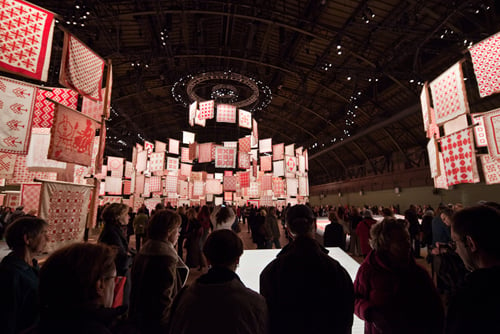
Photo: Tom Hennes, Thinc Design.When you walk into the Park Avenue Armory over the next two days you are likely to gasp at your first glimpse of Infinite Variety: 3 Centuries of Red and White Quilts, 651 American quilts on loan from collector Joanna S. Rose. Suspended invisibly from the 8 story high ceiling of […]
Photo: Tom Hennes, Thinc Design.
When you walk into the Park Avenue Armory over the next two days you are likely to gasp at your first glimpse of Infinite Variety: 3 Centuries of Red and White Quilts, 651 American quilts on loan from collector Joanna S. Rose. Suspended invisibly from the 8 story high ceiling of the 55,000-square-foot Wade Thompson Drill Hall, the quilts hang in three tiers, back to back, arranged in 13 round “pavilions.” From any vantage point, the entire collection may be seen at once. At the center of the hall, directly opposite the entrance, eight chairs sit in a polite circle, evoking a quilting bee, as a tornado of quilts spirals upwards directly above them. The effect calls to mind a Harold Edgerton strobe photograph of playing cards tossed up and frozen in mid-air. In the fairly dark room, the dramatically illuminated quilts have a commanding presence. The collection’s unified color scheme and dazzling array of patterns inspires feelings of awe and even evokes the sublime. Sponsored by the American Folk Art Museum, the show will be on display until March 30.

Photo: Tom Hennes, Thinc Design.
Far too many exhibition layouts leave viewers confused about where to start and where to finish; people tend to wander around looking perplexed. While most exhibits are linear, with a specific viewing order predetermined by the curators, this one is porous and pliable. Each person chooses a unique path, circling around and through, in and out and back again. The show is both corporeal and ethereal, allowing a viewer to appreciate the massiveness of the Armory’s interior, to marvel at the sheer number and variety of things on display, and to imagine the hours the women spent quilting.
The vastness of the Armory can make it a challenging place to look at art, but Thinc Design created a scheme that makes the best imaginable use of the cavernous Drill Hall, originally designed to train soldiers. The graphic spectacle created by the quilts encourages us to see them anew, not just as folk art or historic textiles. Here, they transcend their reality to become architecture and environment, breaking down into components of abstract color and rhythm.

Photo: Angela Riechers
The concept for the exhibit grew in part from Mrs. Rose’s wish to see her collection at once (for years she kept her quilts folded in a closet, never really seeing what she had). Curators Stacy Hollander and Liz Warren also wanted to avoid typical museum categorizations (grouping quilts by pattern, time period, or geographic origin) in favor of making a visually compelling composition. “People don’t typically notice exhibit design—and if they do, maybe you’ve overshadowed the art—but this was a good case of harmony,” notes Tom Hennes, principal of Thinc Design. “We designed it for permeability; you can focus on what’s in front of you or beyond you, it’s your choice. The quilts are in dialog with each other because of the open space. Personally, I’m now in love with variations on polka dots. Each time, I notice one I hadn’t seen before.”
Which brings up the question of how to really appreciate a quilt hanging eighteen to twenty feet overhead: There’s an app for that. A free iPad app is available for download (though at 500 MB, it takes a while), or visitors can borrow an iPad and stroll through the show with it. (An identical app for the iPhone was inexplicably held up in Apple’s approval process, and was not available in time for the exhibit.) To view a quilt on the iPad, locate it on the floor plan, identify which pavilion and tier it falls in —top, middle, or bottom—and then zoom in for a closer look.

Photo: Tom Hennes, Thinc Design.
Incorporating rich mobile content into an exhibit can function as a visual magnet, drawing a disproportionate share of attention, and resulting in people staring at screens instead of at the real objects on display. In this case the iPad content allows the huge scale exhibit to maintain a human dimension, encouraging us to peer closely at tantalizing objects placed well beyond the scope of our eyesight.
A slight disappointment with the exhibit is the lack of museum-label-style info for each quilt on the iPad. We couldn’t find the name of pattern, the maker or approximate date she worked on the piece. Cell phone-accessible audio files provide some of this information throughout the exhibit. But overall very little background is provided on individual quilts. “The hitch was that Mrs. Rose didn’t gather provenance or scholarship on the quilts, she just collected them,” explains Sherri Wasserman, a strategist at Thinc. “Liz Warren is doing that work now for the catalog and we’ll update the app as it becomes available. We’ll also add additional audio files to the app that didn’t make it in time for the exhibit. Part of what we had hoped for was that the app would both serve as a launching point to look at the physical objects more closely while you’re there, and then as a way to refresh your memory so that when you get home you can study your favorites more closely as a separate, powerful, private experience.”

Photo: Tom Hennes, Thinc Design.
Observing people buzz in and out through the small gaps between the hanging quilts, it’s impossible to miss how happy they look, smiling broadly, pointing at their favorites, calling excitedly to friends to come see. One woman and her children made a game of finding all the quilts patterned with animals. On all scales, from architectural to intimate, Infinite Variety is a 360-degree immersive experience that fuses both the whole and the parts into a transcendent example of the art of exhibition design. As Tom Hennes put it, “It’s a great case of seeing the forest and the trees at the same time.”
Angela Riechers is a design writer and creative director, and a 2010 AOL Artists 25 for 25 grant recipient for Sites of Memory and Forgetting, an interactive memento mori project. @AngelaRiechers (Twitter), www.angelariechers.com/nounverbdesign/ (blog).


